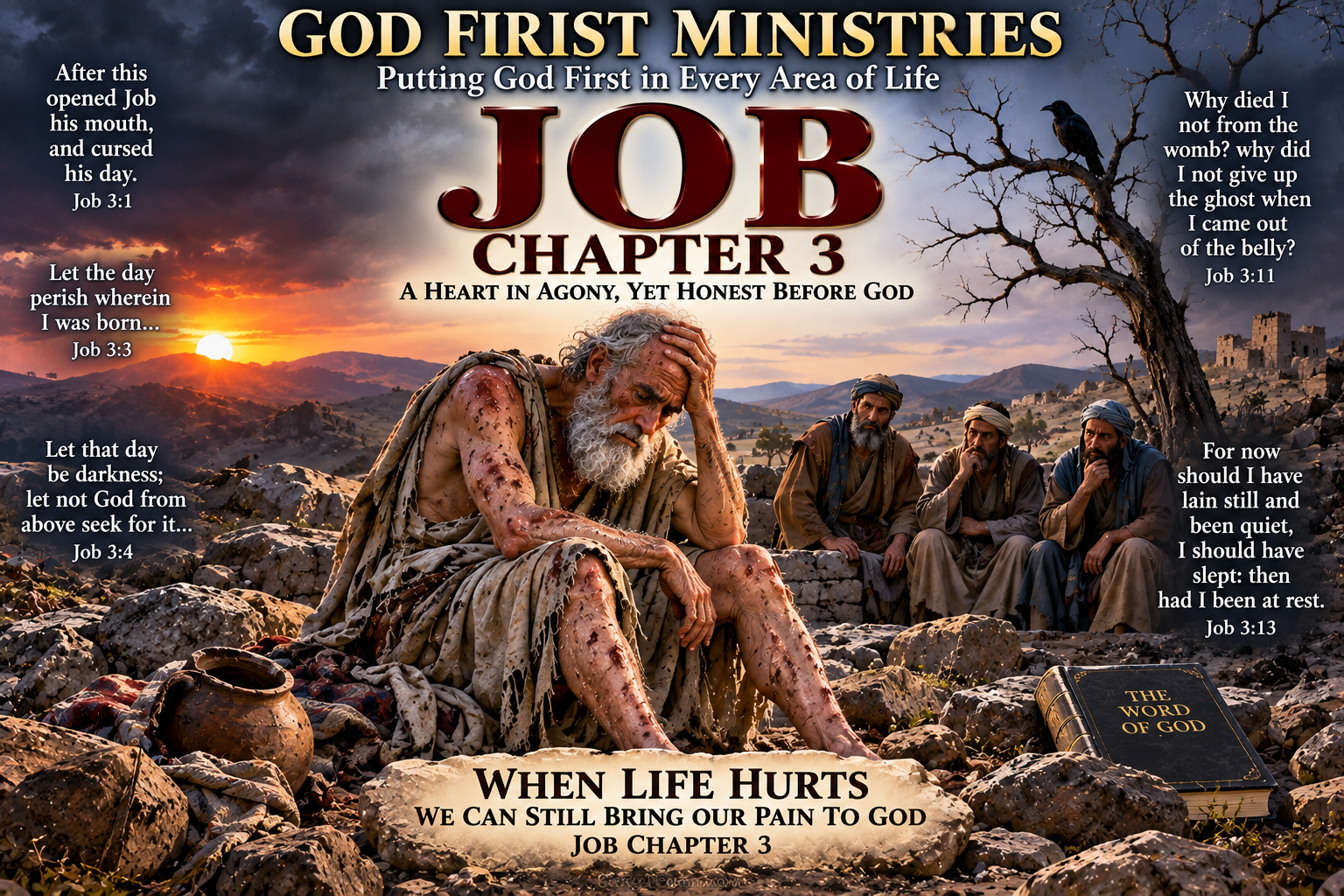
Job Chapter 3 Explained
When Sorrow Finds Its Voice.
Job chapter 3 records Job’s first words after seven days of silence. He does not curse God, as Satan predicted, but he does curse the day of his birth. His suffering has become so overwhelming that he wishes he had never been born.
Job curses the day of his birth — verses 1–10
Job cries:
“Let the day perish wherein I was born.”
—Job 3:3
Job had lost his children, possessions, health and place in society. His grief was so deep that he wished the day of his birth could be removed from history.
This does not mean that Job rejected God. It shows that even a faithful believer can become emotionally exhausted and speak honestly from a broken heart. Job did not take his own life, but he wished that his life had never begun.
Job wishes he had died at birth — verses 11–19
Job asks why he did not die at birth. He imagines death as a place where the weary rest, prisoners are free from oppression, and servants are no longer under their masters.
Job was not giving a complete teaching about life after death. He was speaking from within his suffering. To him, death appeared to offer the rest that life had taken away.
His questions were not the words of a man without faith; they were the cries of a man who could not understand why God had allowed him to live through such terrible pain.
Job asks why suffering people remain alive — verses 20–23
Job asks:
“Wherefore is light given to him that is in misery, and life unto the bitter in soul?”
—Job 3:20
He could not understand why people who longed for death continued to live. Job felt trapped and believed that his way was hidden.
However, Job’s suffering was not hidden from God. Although Job could not see what was happening in the spiritual realm, God still saw him and had not abandoned him.
Sometimes we may not understand why God allows a trial to continue. We see only the darkness surrounding us, but God can see the complete story.
Job describes his fear and unrest — verses 24–26
Job concludes:
“For the thing which I greatly feared is come upon me.”
—Job 3:25
Job had feared that tragedy might strike his family, and now his greatest fear had become a reality. He had no ease, quietness or rest—only trouble.
This shows that Job was not a man without human weakness. He was faithful, but he still experienced fear, grief and confusion. Faith does not mean that we never feel sorrow. It means that, even in our sorrow, we continue turning towards God.
Lessons from Job Chapter 3
Job chapter 3 teaches us that we should not condemn suffering people for expressing their pain. Sometimes those who are grieving do not need an immediate explanation—they need someone to sit beside them, listen and pray.
God is not frightened by our honest questions. Job poured out his anguish, yet he did not abandon God. The Lord knew that Job’s words came from a wounded and exhausted heart.
We should also remember that Job did not know the end of his story. He could see only his present suffering, but God already knew that restoration would come.
Child of God, your darkest chapter is not necessarily the final chapter. When you cannot understand God’s ways, hold on to His character. He still sees you, loves you and remains with you in the darkness.
“Weeping may endure for a night, but joy cometh in the morning.”
—Psalm 30:5
For Georges Web Ministries
6th September 2026
God is a good God
God Knows , God Loves. God cares
Leave a Reply