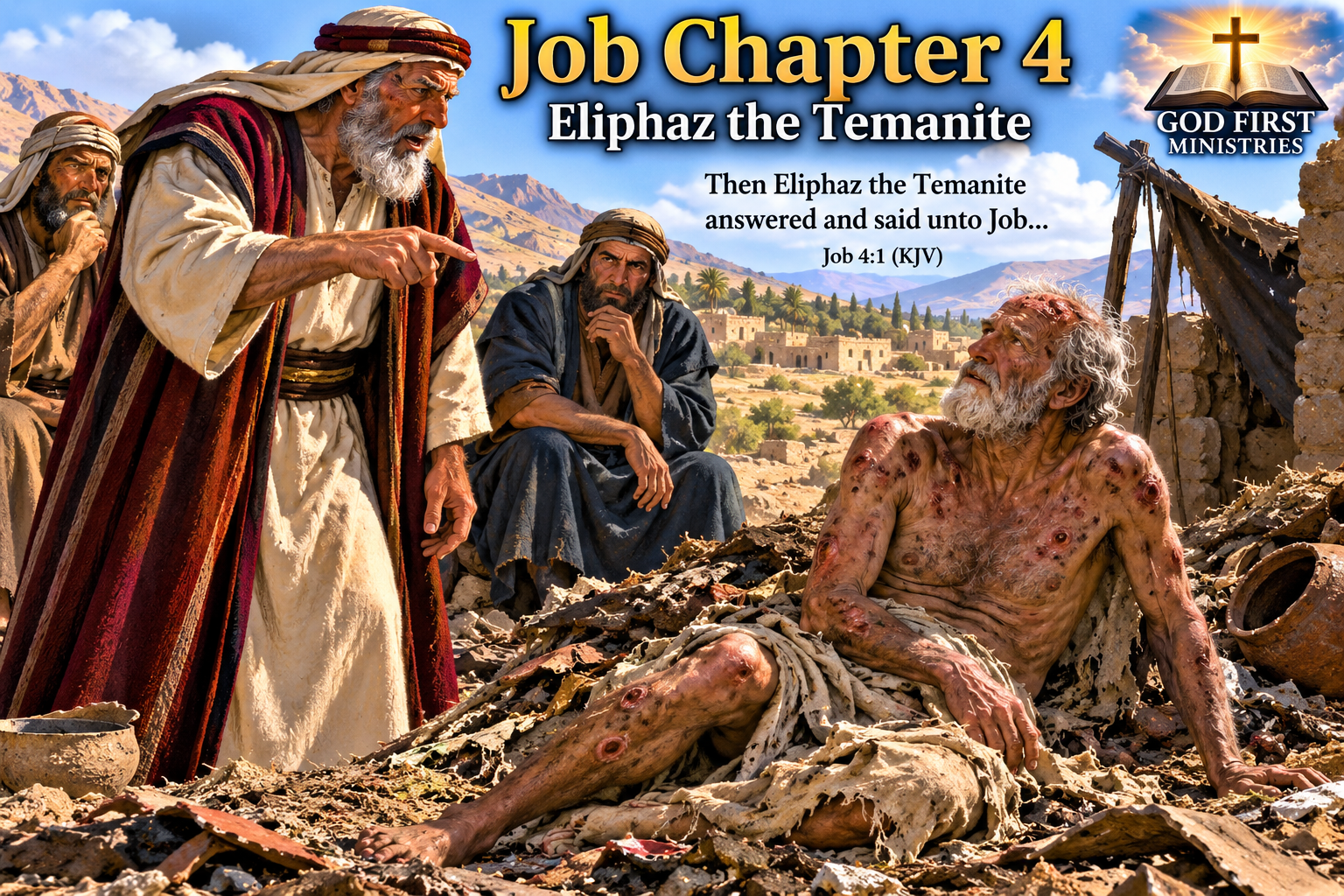
Job Chapter 4 Explained
Eliphaz Speaks—but Misunderstands Job
Job chapter 4 begins the first speech from Eliphaz, one of Job’s three friends. After sitting silently with Job for seven days, Eliphaz finally responds to Job’s sorrow. Some of his words sound wise, but he makes a serious mistake: he assumes that Job’s suffering must be punishment for sin.
1. Eliphaz Reminds Job of His Former Strength
Job 4:1–6
Eliphaz reminds Job that he had previously encouraged the weak, supported those who were falling, and strengthened troubled hearts. Yet now that suffering has entered Job’s own life, Eliphaz suggests that Job has become discouraged.
There is a lesson here for us: it is sometimes easier to comfort others than to endure suffering ourselves. Nevertheless, Job needed compassion—not criticism. A hurting person does not always need a lecture; sometimes they simply need a friend who will listen and pray.
2. Eliphaz Assumes Job Must Be Guilty
Job 4:7–11
Eliphaz asks:
“Who ever perished, being innocent? or where were the righteous cut off?”
—Job 4:7
He believed that innocent people do not suffer severely and that trouble only comes to those who deserve it. He compares life to sowing and reaping: those who sow wickedness will reap trouble.
It is true that sinful choices can bring painful consequences. However, Eliphaz wrongly applies this truth to Job. The opening chapters tell us that Job was upright and faithful. His suffering was not punishment for some hidden wickedness.
We must be careful not to judge people by their circumstances. Poverty, illness, bereavement or hardship do not necessarily mean that someone has sinned or that God has rejected them.
3. Eliphaz Describes a Frightening Vision
Job 4:12–17
Eliphaz tells Job about a mysterious experience during the night. He felt fear, trembling and the presence of a spirit. A voice asked:
“Shall mortal man be more just than God? shall a man be more pure than his maker?”
—Job 4:17
The statement that no human being is more righteous than God is certainly true. Yet Eliphaz uses it to suggest that Job must have done wrong. A true statement can still be used in an unhelpful way when it is applied without understanding, mercy or love.
Every spiritual experience should be examined in the light of God’s Word. We should never use a dream, vision or feeling to condemn someone without knowing the truth.
4. Human Beings Are Weak Before God
Job 4:18–21
Eliphaz speaks about the weakness of humanity. People live in bodies made from dust, and earthly life can quickly come to an end. Compared with the eternal wisdom and holiness of God, human understanding is very limited.
Eliphaz is correct about human frailty, but his conclusion concerning Job is wrong. He understands an important principle, yet he does not understand what God is doing in Job’s life.
The Main Lesson
Job chapter 4 teaches us that religious-sounding words are not always the right words. Eliphaz spoke about God, righteousness and human weakness, but he lacked compassion and wrongly judged his suffering friend.
When someone is experiencing sorrow, we should not immediately ask, “What have they done wrong?” Instead, we should ask, “How can I show them the love of Christ?”
God sometimes permits trials for reasons that we cannot see. Therefore, let us comfort the broken-hearted, pray for those who suffer and leave final judgement in the hands of the Lord.
“Bear ye one another’s burdens, and so fulfil the law of Christ.”
—Galatians 6:2
Prepared for God First Ministries
For Georges Web Ministries
7th September 2026
God is a good God
God Knows , God Loves. God cares
Leave a Reply