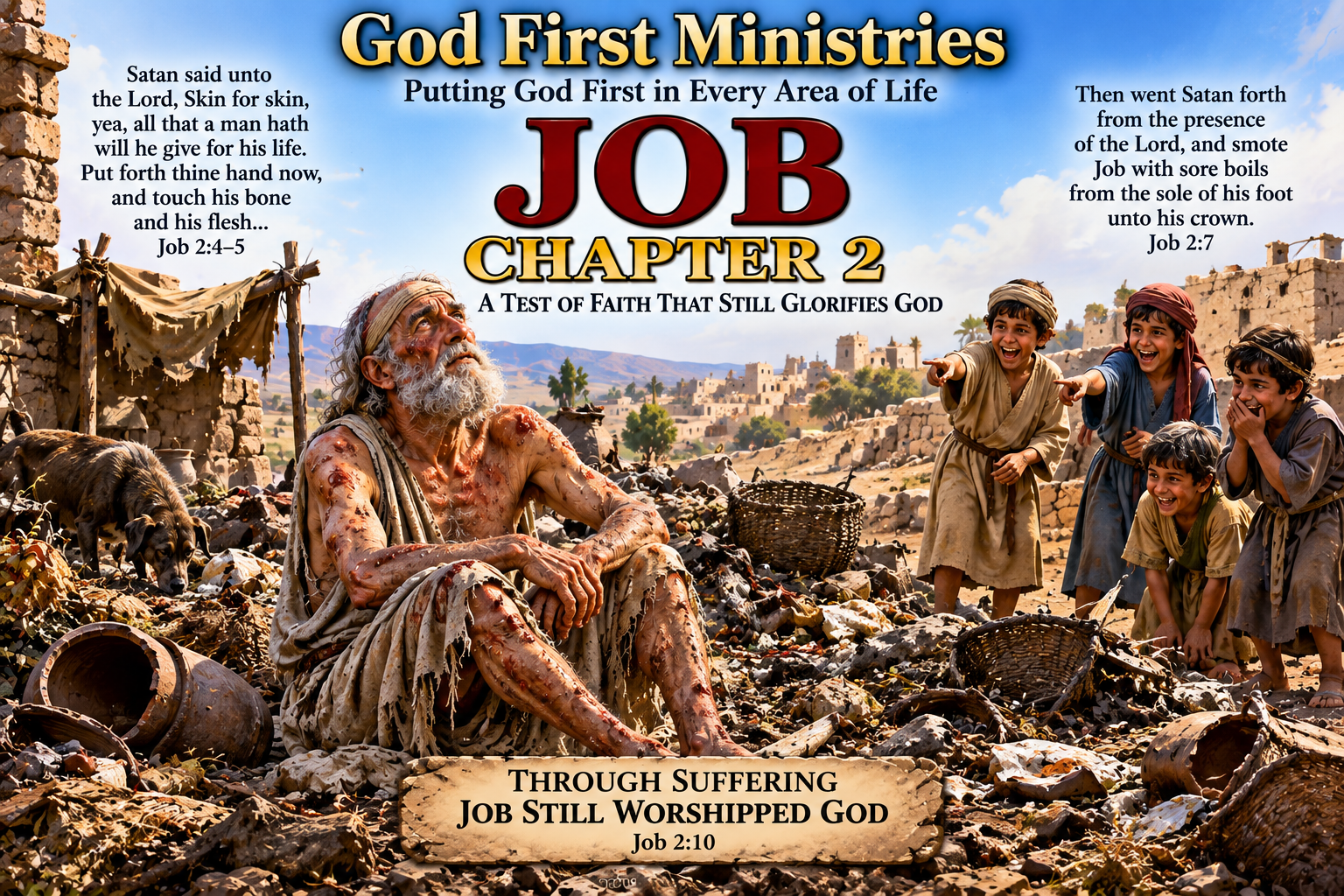
Holding On When Everything Goes Wrong
A Sermon from Job Chapter 2
Main text:
“What? shall we receive good at the hand of God, and shall we not receive evil?”
—Job 2:10
Job chapter 2 brings us face to face with a difficult question: Will we continue to trust God when everything goes wrong?
It is easy to praise the Lord when our health is good, our family is safe, our needs are supplied and our prayers are being answered. But what happens when trouble enters our home? What happens when our health fails, sorrow breaks our heart and God seems silent?
Job had lost his wealth, his servants and all ten of his children. Yet his suffering was not over. Satan wanted to prove that Job loved God only because of what God had given him.
The great test of Job’s faith was this: Would he continue to worship God when the blessings were gone?
1. Satan’s power is limited
Once again, Satan appeared before the Lord. God spoke about Job’s faithfulness:
“And still he holdeth fast his integrity.”
—Job 2:3
Job had been shaken, but he had not been separated from God. His heart was broken, but his faith was still standing.
Satan then claimed that Job would turn against God if his body were afflicted:
“Skin for skin, yea, all that a man hath will he give for his life.”
—Job 2:4
God permitted Satan to test Job physically, but He placed a clear limit upon him:
“Behold, he is in thine hand; but save his life.”
—Job 2:6
Satan is powerful, but he is not all-powerful. He cannot go one step beyond what God allows. The enemy may roar like a lion, but he is still under the authority of Almighty God.
Child of God, your trial may feel out of control, but Heaven has not lost control. God knows where you are, what you are suffering and how much you can bear.
2. Faith does not make us immune to suffering
Satan struck Job with painful boils from the soles of his feet to the crown of his head. Job sat among the ashes and scraped his sores with a broken piece of pottery.
This was the same Job who had once been wealthy and respected. Now he was sitting in misery, hardly recognisable.
Some people wrongly believe that if we have enough faith, we will never become ill, suffer loss or experience sorrow. Job’s life proves otherwise. He was not suffering because he lacked faith. He was suffering while demonstrating extraordinary faith.
Trials are not always evidence that God is punishing us. Sometimes we suffer because we live in a fallen world. At other times, God permits a trial that will deepen our faith and reveal His sustaining grace.
We should therefore be careful before judging someone who is suffering. We do not know the battle they are facing or what God may be accomplishing through their pain.
3. Be careful whose advice you follow
Job’s wife saw her husband’s terrible condition and said:
“Dost thou still retain thine integrity? curse God, and die.”
—Job 2:9
We should remember that Job’s wife was also grieving. She had lost her children, her security and the life she had known. Her words came from a heart overwhelmed by sorrow.
However, her advice was wrong. Without realising it, she was encouraging Job to do exactly what Satan wanted.
During our darkest moments, someone may advise us to give up praying, abandon our faith or become bitter against God. Not every voice should be followed. Every piece of advice must be measured against the Word of God.
When others lose their faith in your situation, do not allow them to speak unbelief into your heart. Hold on to what God has said.
4. Job refused to curse God
Job replied to his wife:
“Thou speakest as one of the foolish women speaketh.”
—Job 2:10
Notice that Job did not call his wife a foolish woman. He said she was speaking like one. Although he was suffering, he still corrected her words without rejecting her as a person.
Then Job asked:
“What? shall we receive good at the hand of God, and shall we not receive evil?”
—Job 2:10
The word “evil” here means adversity, trouble or calamity—not sinful or moral evil. Job was saying, “If we gladly accept God’s blessings, should we reject Him when He permits suffering?”
Job did not worship the blessings; he worshipped the One who had given them.
If our faith exists only while God gives us what we want, then we are trusting His gifts rather than trusting Him. True faith says, “Lord, I do not understand what You are doing, but I will not turn away from You.”
5. It is possible to suffer without sinning against God
The chapter records:
“In all this did not Job sin with his lips.”
—Job 2:10
Job experienced deep pain, but he did not curse God. He could not understand his circumstances, yet he guarded his words.
Words spoken during suffering can either honour God or wound others. Pain may tempt us to become bitter and accuse the Lord of abandoning us. Job teaches us to bring our sorrow honestly before God without turning our sorrow into rebellion against Him.
Faith does not mean that we never cry. Faith means that through our tears, we continue to trust.
6. Sometimes the best ministry is simply being present
Job’s three friends—Eliphaz, Bildad and Zophar—came to comfort him. When they saw him, they could hardly recognise him. They wept, tore their clothes and sat with him for seven days and seven nights without speaking.
Before they began offering explanations, they gave Job the gift of their presence.
When someone is grieving, we may not know what to say. We do not always need to provide an answer. Sometimes the most loving thing we can do is sit beside them, listen to them, pray for them and let them know they are not alone.
A silent friend can be more comforting than someone who gives careless explanations.
7. Christ understands our suffering
Job’s suffering points us towards Jesus Christ. The Lord Jesus was rejected, despised and acquainted with grief. He suffered even though He was completely innocent.
On the cross, Jesus bore our sins and endured suffering so that we could receive forgiveness and eternal life. Because Christ suffered, He understands the broken-hearted. We do not serve a Saviour who is distant from our pain.
When we pass through the furnace of affliction, Jesus walks with us. He may not remove the trial immediately, but He will never abandon His children.
“I will never leave thee, nor forsake thee.”
—Hebrews 13:5
Conclusion: Hold on to your integrity
Satan touched Job’s possessions, family and health, but he could not force Job to curse God. Job continued to hold firmly to his integrity.
Perhaps you are facing a trial that you cannot understand. You may feel as though everything has been taken from you. People around you may offer discouraging advice, and Heaven may seem silent.
But God has not forgotten you.
Do not measure God’s love by your present circumstances. Look instead to the cross, where His everlasting love was demonstrated. The same God who was with you upon the mountaintop remains beside you in the valley.
Child of God, hold on. Keep praying. Keep believing. Keep trusting the Lord. The enemy wants your suffering to drive you away from God, but let it drive you nearer to Him.
You may not understand God’s hand, but you can always trust His heart.
Closing Prayer
Heavenly Father, when trials come and we cannot understand what You have permitted, help us to trust You. Guard our hearts from bitterness and our lips from speaking against You. Give strength to those who are suffering, comfort those who are grieving and remind them that they are not alone. Help us to remain faithful in good times and in difficult times. May our lives declare, as Job did, that we will continue to trust You. In the precious name of Jesus, Amen.
God First Ministries.uk
For Georges Web Ministries
5th September 2026
God is a good God
God Knows , God Loves. God cares
Leave a Reply